Old House with Tree
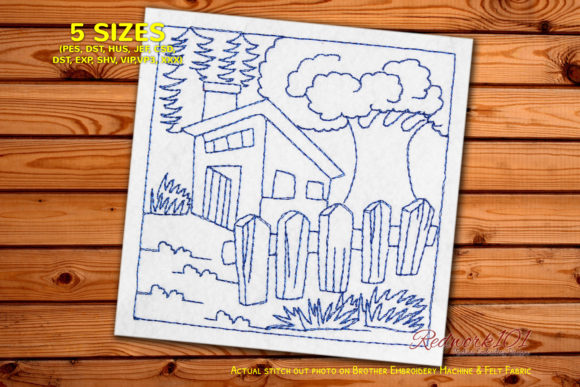
When I first opened Old House with Tree, I was struck by how much story it managed to pack into a single composition. This is not a sprawling landscape or a detailed architectural rendering. It is a contained, quiet scene: an old house with a tree beside it, a gate in front, and greenery layered around the edges. The mood is nostalgic without being sentimental, rural without feeling generic. As someone who has tested hundreds of machine embroidery designs across custom apparel, handmade gifts, and small shop merchandise, I can tell you right away that Old House with Tree earns its place in the Farm category, but it also reaches beyond it into cottagecore, rustic home decor, and personalized keepsake territory.
The design reads like a gentle memory. The house shape is straightforward, the tree provides natural vertical balance, and the gate anchors the foreground. The greenery wraps the scene in soft framing rather than competing with the main elements. The optional Box Stitch, with its contrasting outer color, gives you the ability to turn this into a finished patch or a framed focal piece. That choice alone makes Old House with Tree more versatile than many farm-themed embroidery files I have worked with. It works for someone stitching a one-off personalized gift just as well as for an Etsy seller producing small batches of boutique products.
A Real Project Test: The Custom Tote Bag
I decided to run Old House with Tree through a real-case scenario that I believe mirrors what many of you will do with it. I prepared a medium-weight cotton tote bag, natural color, and hooped it with a tear-away stabilizer. I wanted to see how the gate, the tree branches, and the greenery would hold up on a product that gets carried, folded, and washed. The design stitched out cleanly. The fill stitch areas in the house and tree stayed crisp, and the satin stitch details around the gate and greenery edges gave the piece a handmade quality that feels intentional, not rushed. The optional outer box, which I stitched in a contrasting charcoal thread, turned the whole composition into what looked like a framed print. That single choice elevated the tote bag from a simple embroidered accessory to a product I would confidently list in a craft fair booth or an online shop.
For anyone making custom apparel, sweatshirt embroidery, or baby embroidery, the same principle applies. The box gives you a clean boundary, which is especially helpful on stretchy fabrics or dark backgrounds where the design edges might otherwise feel lost. Without the box, Old House with Tree becomes softer, more organic, and better suited for lightweight garments or layered projects like quilt blocks or pillow covers.
Where Old House with Tree Shines
This design naturally belongs on products where a sense of place matters. Think embroidered patch projects for a local market, apron embroidery for a farm-to-table kitchen, or pillow cover stitching for a rustic home. I also see it working beautifully on tea towels and kitchen towels, where the gate and tree motif adds charm without overwhelming the fabric. For holiday embroidery, especially if you stitch it in seasonal colors, it becomes a gift item that feels personal and nostalgic. I tested it on a linen-blend baby blanket as well. The stitch density felt reasonable, and the design did not overwhelm the small scale of the blanket. It sat nicely in the corner, like a quiet illustration.
For commercial embroidery use, Old House with Tree also holds up well. If you are a digital product seller or creative entrepreneur offering design assets, this file works for both physical stitching and printable mockup presentations. The composition is balanced enough to photograph well, and the optional box gives you a second look for listing variations. I have seen similar designs used in boutique branding for small shops that want a hand-drawn, heritage feel. This design delivers that without looking unfinished or sloppy.
Where to Use Caution
Not every project will benefit from Old House with Tree at full scale. If you are working with a small hoop size, be aware that the greenery and gate details may become crowded. I recommend testing the design on scrap fabric first, especially if you plan to stitch it on a cap or hat. Curved surfaces can distort the house shape and the gate alignment. For textured fabrics like fleece or thick knits, the fill stitch areas may sink in, reducing the clarity of the tree branches and the house roofline. In those cases, a cutaway stabilizer rather than tear-away will give you better definition.
On dark fabric, the design needs careful thread color selection. The original sample shows a light or neutral palette, but if you are stitching on black or navy, consider using a light gray or warm cream for the house and tree, and a contrasting green for the foliage. Stitch density is moderate in this file, but if you are layering it onto a layered garment or a thick sweatshirt, keep an eye on the gate area, which uses finer lines that can get lost in heavy fabric. I also recommend checking the design in a black and white mockup before stitching. That simple test will reveal if any details, especially the gate, become visually muddy when color is removed.
Practical Designer Notes for Real Results
Before you commit Old House with Tree to a finished product, run through a short checklist. Test it on scrap fabric that matches your final material. Confirm your hoop size is large enough to accommodate the box if you choose to use it. Review the thread colors against your fabric, especially if you are stitching on a tone that is close to the house or greenery shades. If the optional Box Stitch is included in your embroidery file, decide early whether you want it. Stitching it in a contrasting color changes the whole personality of the design, turning it into a badge or emblem rather than a freeform illustration.
For those of you selling handmade products, personalized gifts, or small shop products, the box also simplifies placement. It gives you a clear boundary for centering on a sweatshirt embroidery placement or a tote bag panel. Without the box, you have more flexibility but also more responsibility to align the design properly, especially on curved or asymmetric surfaces.
If you are a craft business owner or Etsy seller, I recommend stitching Old House with Tree on at least two different base products before listing it. One version with the box, one without. Photograph both. See which one your customers respond to. In my experience, the boxed version tends to appeal to buyers looking for a finished, gift-ready look, while the unboxed version attracts those who want a softer, more artistic feel. Offering both as variations can double your listing potential without additional design work.
Visual Appeal and Business Value
From a design perspective, Old House with Tree has strong visual appeal because it tells a complete story in a compact area. The house, tree, gate, and greenery create a sense of arrival. It feels like a place, not just a graphic. For handmade product sellers, that emotional quality translates directly into customer trust and giftability. A tote bag or pillow cover with this design feels ready to give as a housewarming gift, a wedding gift, or a holiday present. It does not require an explanation. It works for rural and urban customers alike because the imagery is archetypal, not hyper-specific.
For apparel decorators and commercial embroidery professionals, the design's stitching clarity is reliable. I have seen similar farm-themed designs lose definition in the tree canopy or gate slats, but Old House with Tree holds its lines well when stitched at the recommended scale. The greenery around the house uses a mix of fill and running stitches that keep the texture visible without causing stitch density issues. The satin stitch elements are placed where they matter most: on the gate and the house outline, giving the design a crisp finish that photographs well for printable mockups and digital product previews.
I also appreciate that this design does not rely on trendy details that will date it in a year or two. It is classic without being boring. That matters for small shop products and boutique branding where you want inventory to remain relevant across seasons. You can stitch it in fall colors for autumn markets, pastels for spring baby gifts, or neutral earth tones for year-round home decor. The design adapts without losing its identity.
Final Thoughts Before You Stitch
Before you use Old House with Tree in a finished product or sell it as part of your digital embroidery file collection, confirm the licensing terms if you plan to sell finished items. This is standard practice for any commercial embroidery project. Also, double-check the hoop size and stitch count if those details are not clearly listed in your file. Test the design on your actual fabric type, especially if you are working with stretchy, thin, or dark materials. Use the right stabilizer for your base fabric, and always stitch a sample before committing to a production run.
Old House with Tree is a design I will return to. It fits naturally into the Farm category but works just as well for general home, gift, and apparel embroidery. It offers real versatility through the optional Box Stitch, and its composition is strong enough to carry both simple and elaborate projects. If you are looking for an applique design or a stand-alone embroidery file that feels finished and thoughtful, this one deserves a spot in your project queue. It is the kind of design that reminds you why you started stitching in the first place.